By Vela Partners

Age of Ventures

The venture capital strategy game, and the world's first reinforcement learning environment for venture capital.

Run a $100M fund for ten years against Andreessen Horowitz, Sequoia, Benchmark and Founders Fund. Every round, exit and shutdown follows odds modeled on real venture data. You play it in your browser; AI agents play the same decisions in GP-Bench.

arXivThe GP-Bench paper: coming soon
Signed in as .

Free. Plays in your browser on a laptop or desktop. A full decade takes about 30 minutes, and you can pause at any time.

Two ways in

The same fund, the same founders and the same rules, whether a person or a model is making the calls.

For people

Play Age of Ventures

Found your firm, pick who you are, and spend a decade as a general partner on a painted map in the style of Age of Empires.

  • Send partners to meet founders and read their notes
  • Invest, lead, negotiate, co-invest or pass
  • Sit on boards, rescue companies, follow on, sell or take them public
  • Raise Fund II and III on your record, and return the fund by 2036
For AI researchers

Train and test agents on GP-Bench

GP-Bench is the environment underneath the game: a venture fund an agent can run from first cheque to final distribution, scored the way real funds are.

  • Evidence, never a score: the agent reads the same memos and partner notes a person does
  • Long horizons: forty quarters between a decision and its outcome
  • Scarce resources: partner time, cash and a management fee
  • Rivals, negotiation and market cycles

How a decade plays

Time flows on its own, about 45 seconds a quarter. Press Space to pause and think. Anything that needs you waits in one list, one decision at a time.

Before 2027
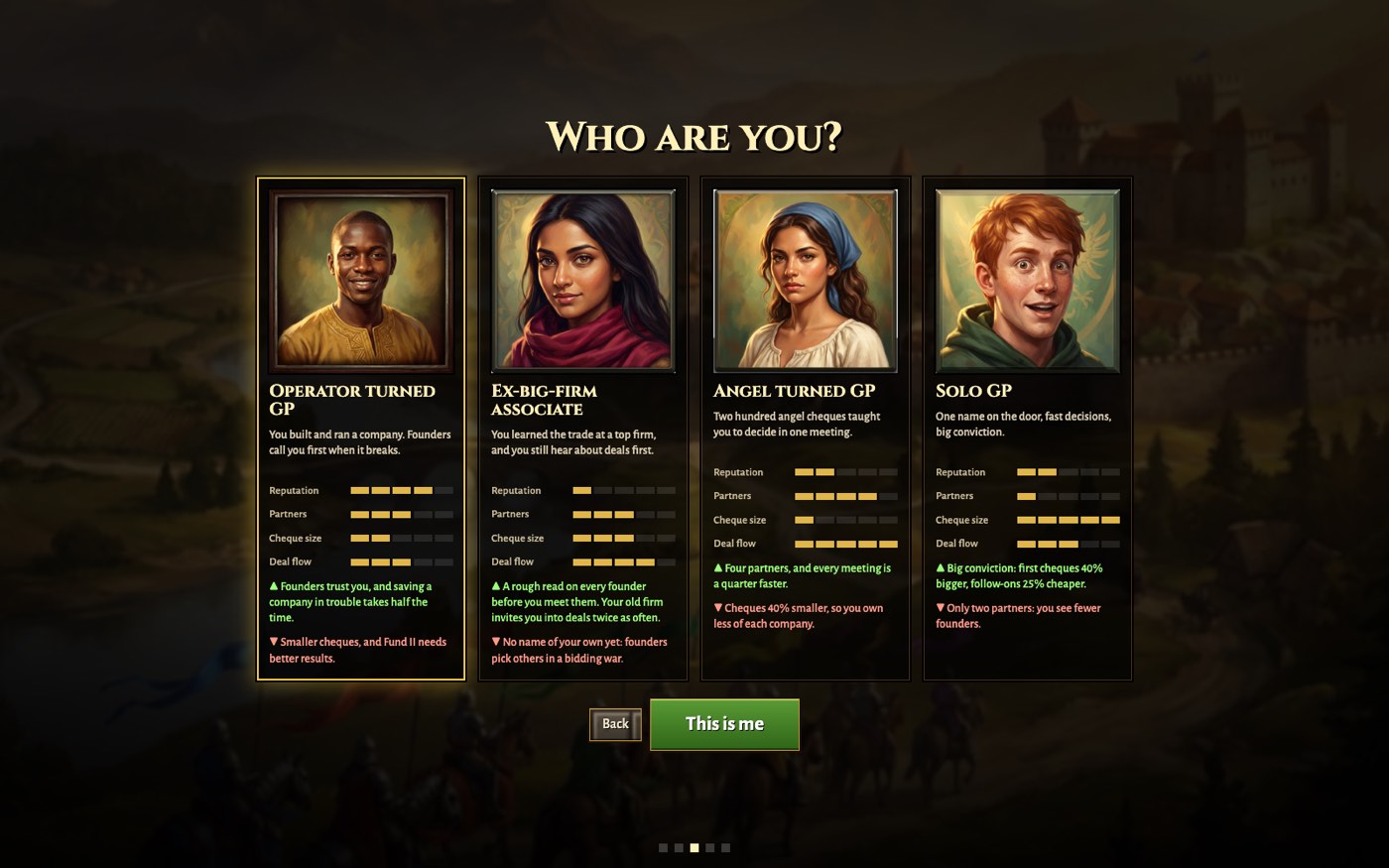
Choose who you are: four GP characters, an operator, an ex-big-firm associate, an angel and a solo GP, each with bars for reputation, partners, cheque size and deal flow

Choose who you are

An operator, an ex-big-firm associate, an angel or a solo GP. Each has a real power and a real weakness: reputation, partners, cheque size or deal flow.

2027
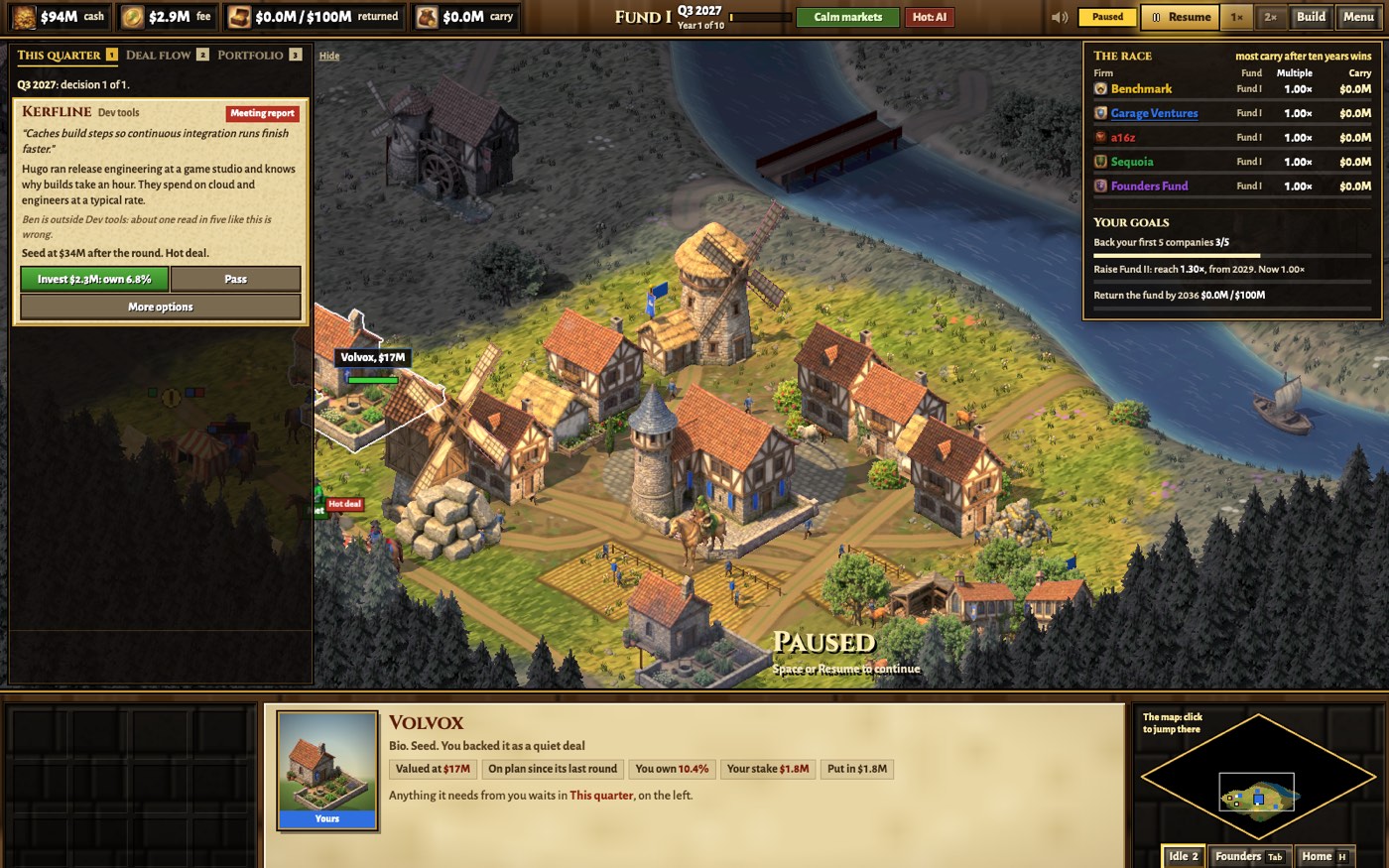
The map in 2027: a meeting report on the left with the founder's background, the partner's notes and the price, and buttons to invest or pass

Find and judge founders

Your partners ride out to meet founders. Their notes say who the founders sell to and how they spend money, and whether the partner knows the sector. Hot deals cost more; quiet ones may be gems.

2029
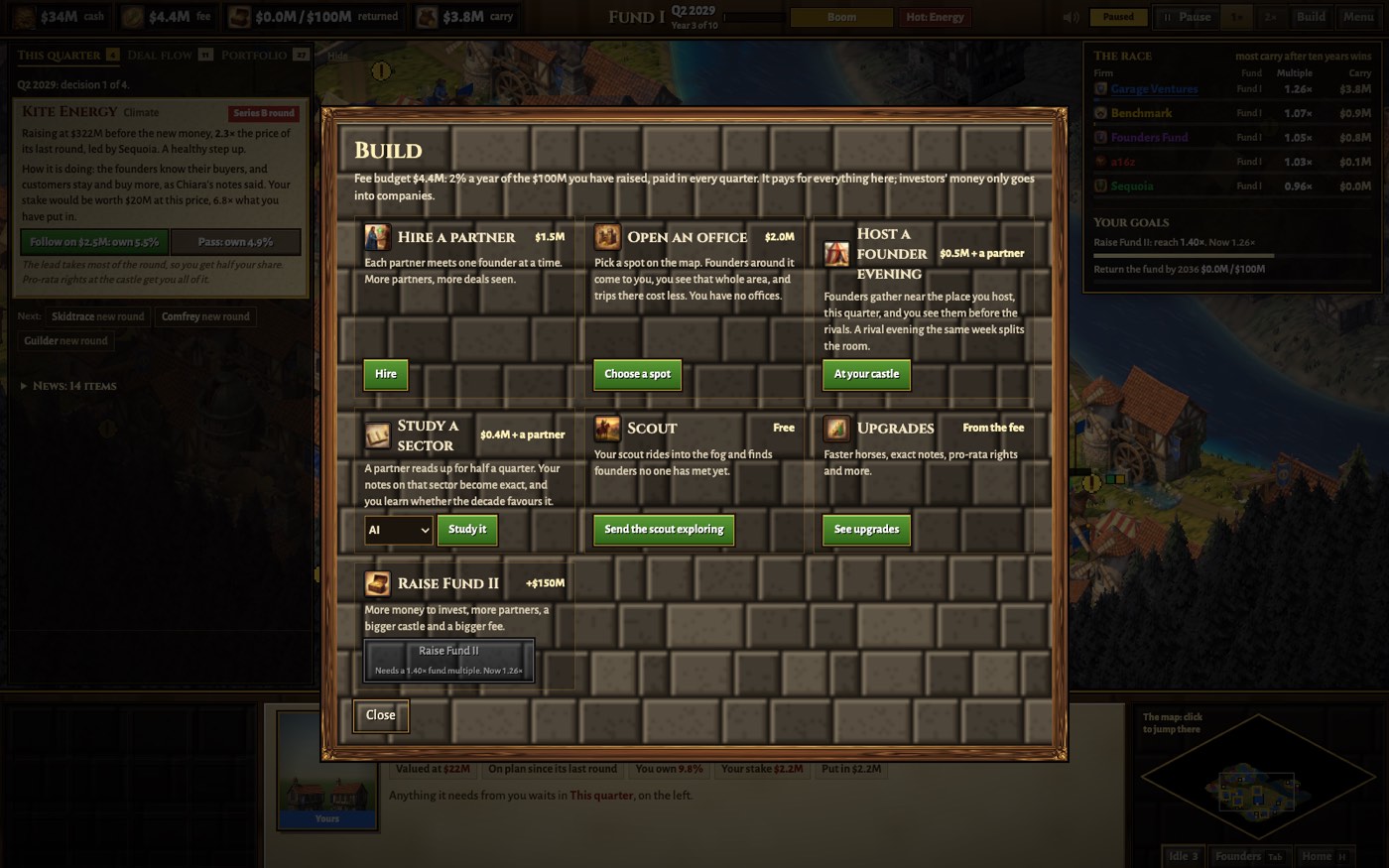
The Build menu: hire a partner, open an office, host a founder evening, study a sector, scout, upgrades and raise Fund II, each paid from the management fee

Build the firm

Your 2% management fee is your economy. Hire partners, open offices across the map, host founder evenings, study a sector, and raise your next fund when your numbers allow.

2036
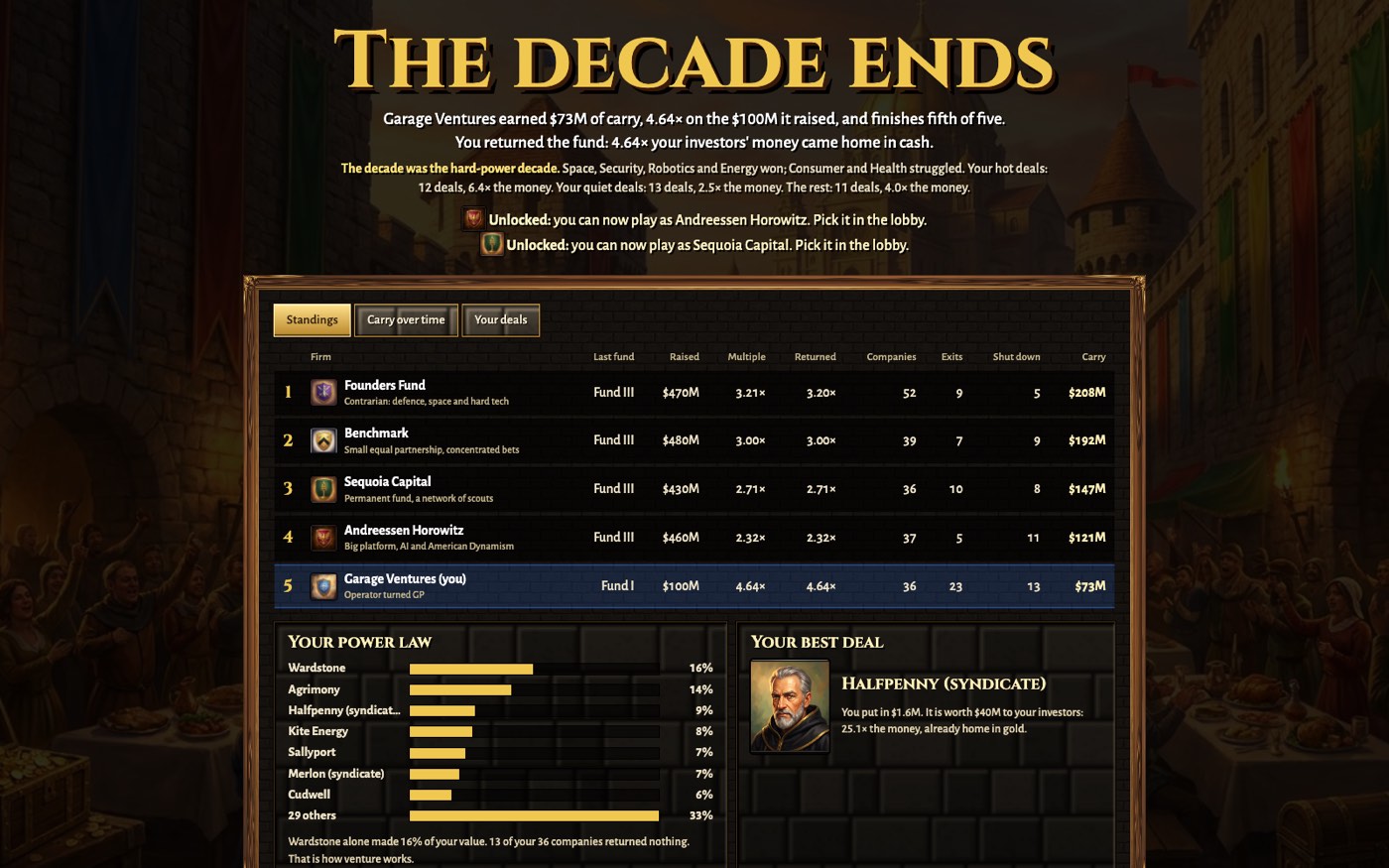
The end screen: the five firms ranked by carry, with money raised, multiple, cash returned, companies, exits and shutdowns, and your power law

Harvest and count

The fund's term ends in 2036, and whatever you still hold sells at a discount. The most carry wins. A few companies make most of the money, and most return nothing.

Modeled on the real world

A venture fund is a long, uncertain game with a few rules that decide everything. These are the rules the environment follows.

Fund economics

A $100M first fund, a ten-year term, a 2% management fee and 20% carry. Funds II and III are raised on your track record, above all on cash returned.

The power law

Most companies return nothing. A few return the fund. Winning means backing the outliers and owning enough of them.

Rounds and dilution

Seed, Series A and B, step-ups and down rounds. Follow on to keep your share; a top firm leading the round squeezes your pro-rata.

Partner time

Meetings take days, and every board seat costs a partner a meeting each quarter. Lead more deals and you meet fewer founders.

Exits and failures

Acquisitions, IPOs, secondary sales, bridge rounds and shutdowns. Companies out of cash get one last chance.

Markets and rivals

Booms, winters and hot sectors. Four rival firms bid for the same founders, open offices near yours, and invite you into their rounds.

What a top-tier lead is worth
Measure, US companiesTop-tier leadOther
Seed reaches Series A (2015–21 seeds)70%30%
Series A reaches Series B (2015–21)75%50%
Series A size ÷ seed size4.8×3.7×

Source: Vela's Crunchbase-based data, about 25,000 rounds. Observed odds, not causes: top-tier firms also pick better companies. In calibration runs the game reproduced Series A to B rates of 79% and 50%. More on the data.

The companies and founders are invented, so nobody can look up the answer. The odds behind them are calibrated to real data where data exists, and set by hand where it does not. The world is stochastic: a good decision can lose, and a bad one can win. Judgement shows over a decade, not a single deal.

GP-Bench, the environment

The world's first reinforcement learning environment for venture capital. The agent is a general partner; an episode is one fund.

Observation
Founder memos and partner notes, prices and terms, the portfolio and its marks, cash, fee, partner time, the market and rivals' moves.
Actions
Meet, invest, lead, negotiate, co-invest or pass; follow on, bridge, sell or list; hire, open offices, host events, study sectors, raise the next fund.
Constraints
Partner hours, board seats, cash and the management fee.
Reward
Carry, the GP's 20% share of profit, and cash returned to investors (DPI) by the end of the term.
Episode
Forty quarters, from 2027 to the end of 2036.

Where it stands

The environment runs inside Age of Ventures today, and you can play it now. An interface for AI agents is in development, and a paper describing GP-Bench is coming to arXiv.

The environment in full, and how agents are scored.

Building investing agents, or studying decisions under uncertainty? Talk to Vela Partners.

arXivThe GP-Bench paper: coming soon

The firms across the map

Each rival plays its publicly known style. When a top firm leads your company's next round, the market notices.

Questions

What is Age of Ventures?

A free strategy game in your browser about running a venture capital fund. You raise a $100M fund in 2027 and have ten years to find founders, invest, sit on boards and return the money, against Andreessen Horowitz, Sequoia Capital, Benchmark and Founders Fund. It is made by Vela Partners.

What is GP-Bench?

The world's first reinforcement learning environment for venture capital, built by Vela Partners. The agent is the general partner of a fund: it sees the evidence a GP sees, chooses among the same actions, spends partner time, cash and fees, and is rewarded on carry and on cash returned. Age of Ventures is the same environment with a playable face.

Is the data real?

The companies and founders are invented. The odds behind them are modeled on real venture data where data exists: for example, in Crunchbase-based data on US companies, seeds led by a top-tier firm reached Series A about 70% of the time against about 30% for other seeds. Fund economics follow the common 2% management fee and 20% carry over a ten-year term.

How long does a match take, and what does it cost?

A full decade takes about 30 minutes at normal speed, and you can pause at any time. It is free; you sign in with Google, and only your Google name and email are kept.

Can AI agents play?

Yes, that is what GP-Bench is for. The environment runs inside the game today; an interface for AI agents is in development, and a paper describing GP-Bench is coming to arXiv.

Are the venture firms in the game real?

The four rival firms are named after real firms and play their publicly known styles. The game is a work of fiction and parody and is not affiliated with or endorsed by any of them.
Your Google name and email are all we keep.